Firearms safety certification Coeur d'Alene, Idaho
Essential Firearms Safety Education for Responsible Ownership
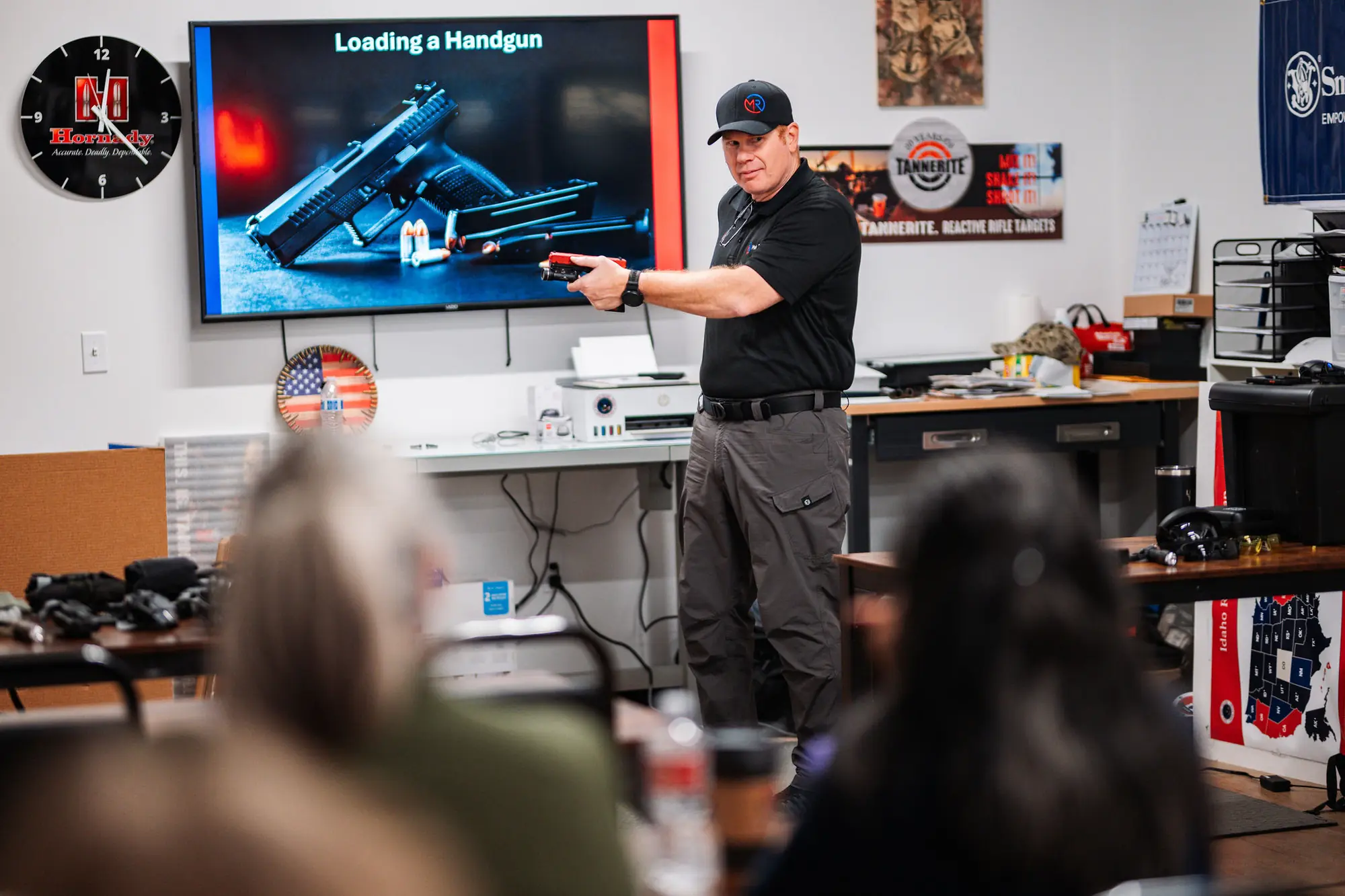
Gun Safety Classes Service in Coeur d'Alene, Idaho
Firearms safety education forms the essential foundation for responsible gun ownership. Our comprehensive safety classes provide critical knowledge and practical skills designed to prevent accidents, promote responsible handling, and develop the confidence necessary for safe firearm operation in any context.
If you're the type to learn by doing and don't want to read all about gun safety classes, simply click the button below to get started now. Otherwise keep scrolling to learn by reading.
Check The ScheduleThese classes are specifically structured for accessibility regardless of prior experience. Whether you're considering your first firearm purchase, have inherited guns without formal training, or are an experienced owner seeking to refresh fundamental safety protocols, our curriculum addresses safety concerns at every knowledge level. The universal principles taught apply to all firearm types and ownership scenarios.
Our safety instruction begins with the four cardinal rules of firearm handling—treating all guns as loaded, maintaining muzzle awareness, keeping fingers off triggers until ready to fire, and knowing your target and what lies beyond. These foundational principles are reinforced through practical exercises, creating muscle memory and habitual safety behaviors that become second nature.
Proper storage and security measures receive significant attention throughout the course. We discuss various storage solutions ranging from quick-access bedside options to long-term storage safes, addressing considerations for households with children, legal requirements in your jurisdiction, and balancing security with accessibility during emergencies. Practical demonstrations of locking devices and safety equipment provide hands-on familiarity.
The mechanical operation of various firearm types is covered in detail, focusing on how safety features function and their limitations. Understanding how and why guns work creates informed users capable of identifying potential malfunctions and unsafe conditions. This technical knowledge builds confidence while dispelling dangerous misconceptions perpetuated by entertainment media and internet forums.
Home safety planning extends beyond storage considerations to address emergency protocols, communication with family members, and creating comprehensive safety systems rather than relying solely on mechanical devices. These discussions include age-appropriate education for households with children and strategies for guests unfamiliar with firearms.
Legal responsibilities of firearm ownership constitute a crucial component of our safety curriculum. We cover relevant local, state, and federal regulations regarding possession, transportation, and use of firearms, though we always recommend consulting legal professionals for definitive legal advice specific to your situation. Understanding these legal frameworks reinforces the serious responsibility gun ownership entails.
Range safety protocols receive practical application during supervised live-fire exercises. Students learn proper range etiquette, command responses, malfunction clearing procedures, and safe handling during various shooting positions. These controlled experiences build competence in managing firearms in active environments while reinforcing classroom concepts through practical application.
The physiological and psychological aspects of safe handling are addressed through discussions of how stress, fatigue, and impairment affect decision-making and fine motor skills. These factors are often overlooked in basic safety instruction but represent critical considerations for truly comprehensive safety protocols in real-world conditions.
Special considerations for different firearm types are thoroughly explored. Handguns, shotguns, and rifles each present unique safety challenges requiring specific handling techniques. Our instruction ensures you understand the appropriate safety protocols regardless of what firearms you currently own or may acquire in the future.
Child safety receives dedicated attention beyond secure storage discussions. We provide research-based approaches to educating children about firearms, developing age-appropriate responses to finding unsecured guns, and creating a household environment that respects rather than mystifies firearms—proven strategies for reducing tragic accidents involving curious youngsters.
Cleaning and maintenance procedures are taught with an emphasis on safety during disassembly, inspection, and reassembly. These essential maintenance skills not only extend the life of your firearms but provide regular opportunities to verify proper functioning of critical safety components and identify potential issues before they create dangerous conditions.
Our certified instructors bring decades of combined experience from military, law enforcement, and civilian training backgrounds. They employ diverse teaching methodologies to accommodate different learning styles, ensuring every student thoroughly understands and can demonstrate each safety principle regardless of how they best process information.
Certificate of completion provides documentation of your commitment to responsible ownership—often useful for insurance purposes, club memberships, or family peace of mind. While not a replacement for ongoing practice, this recognition represents the beginning of a lifetime safety journey rather than a terminal achievement.
Small class sizes ensure personalized attention during all demonstrations and practical exercises. Our instructor-to-student ratio exceeds industry standards, providing constant supervision and immediate feedback during all handling exercises. This controlled environment allows questions and clarifications at any point in the instruction.
Register today to secure your place in our regularly scheduled safety classes. This foundational course often serves as a prerequisite for more advanced training, but more importantly, it establishes the critical mindset and habits that define truly responsible firearm ownership for a lifetime of safe enjoyment and confidence.
Gun Safety Classes FAQs
Our pistol and rifle instruction classes are capped at 18 students. Holding the group to that size means every student actually gets watched and corrected on the fundamentals instead of sitting through a lecture. Pistol 101 and Carbine 101 are the classroom based safety courses with no live fire, and both run under that same cap. Call (208) 704-2355 to check seat availability for an upcoming date.
Pistol 101 and Carbine 101 are six hour classroom courses with no live fire. Six hours gives us room to cover the safety rules, how the firearm functions, loading and unloading, safe storage, and hands on handling with unloaded firearms without rushing any of it. Exact start and end times for each session are posted on the class schedule page.
For Pistol 101 and Carbine 101, bring something to take notes with, water, and a snack. Those classes have no live fire, so no firearm, ammunition, or eye and ear protection is required, and we provide the firearms students handle in class. If you are registered for Pistol Essentials or Carbine Essentials, which do include live fire, bring your own pistol or carbine, ammunition, magazines, eye and ear protection, and a holster for pistol classes.
Yes. We arrange dedicated safety sessions for women, couples, families, and other private groups on request, using the same curriculum in a setting where everyone shares a similar experience level and similar concerns. Call (208) 704-2355 with your group size and preferred dates and we will schedule one.
Every class is taught by Chris Schaefer, the owner. Chris spent over 23 years in law enforcement, most of it on patrol and as a field training officer teaching new officers to be safe and effective, and he has spent more than ten years training with leading firearms instructors. His credentials include Tactical Hyve Certified Instructor, the Handgun Instructor Development Course through Tactical Performance Center, NRA Instructor, NRA Range Safety Officer, and USCCA Instructor. That background is why the classes teach why a technique works rather than just drilling the technique.
A safety class teaches you how to own and handle a firearm without hurting anyone. A shooting class teaches you how to hit what you aim at. Pistol 101 and Carbine 101 are our safety and handling classes, held in a classroom with no live fire. Pistol Essentials and Carbine Essentials are shooting classes that include live fire on the range. If you are brand new, take the safety class first.
Yes, and training before your first purchase is the ideal order. Pistol 101 and Carbine 101 are classroom based with no live fire, and we provide the firearms students handle in class, so you can learn how guns function and what safety features do and do not do before you buy anything. Call (208) 704-2355 and we will point you to the right starting class.
Safe storage keeps the firearm out of reach of anyone who should not have it while still being reachable by you. We cover the trade offs between quick access bedside safes, cable and trigger locks, and full size safes, and we cover the habits that matter as much as the hardware: controlling keys and codes, deciding whether ammunition is stored separately, and teaching children what to do if they ever find an unsecured gun. The right setup depends on your home, your children's ages, and how quickly you need access.
Yes. This is exactly the situation our safety classes are built for. Pistol 101 and Carbine 101 are classroom based with no live fire, so you can learn how the guns you inherited actually function, how to verify whether one is loaded, how to unload it safely, and how to store it. Call (208) 704-2355 and tell us what you inherited so we can point you to the right class.
Idaho does not require a safety class to purchase a firearm, and Idaho allows permitless concealed carry for qualifying residents. Idaho's enhanced concealed weapons license is different, because it requires a separate, state mandated eight hour course with its own requirements. Confirm current law for your situation with the Idaho State Police or a qualified attorney.
Some do and some do not. Pistol 101 and Carbine 101 are classroom based safety and handling courses with no live fire at all. Pistol Essentials and Carbine Essentials are the next tier up and do include live fire on the range. Live fire is never an optional add on, so the class description tells you exactly which type you are registering for.
The four universal rules are: treat every firearm as if it is loaded, never let the muzzle cover anything you are not willing to destroy, keep your finger off the trigger until your sights are on the target and you have decided to fire, and know your target and what is beyond it. Every class we teach reinforces these four rules before anything else happens.